AI in Energy Management: Planning, Forecasting, and Explainability

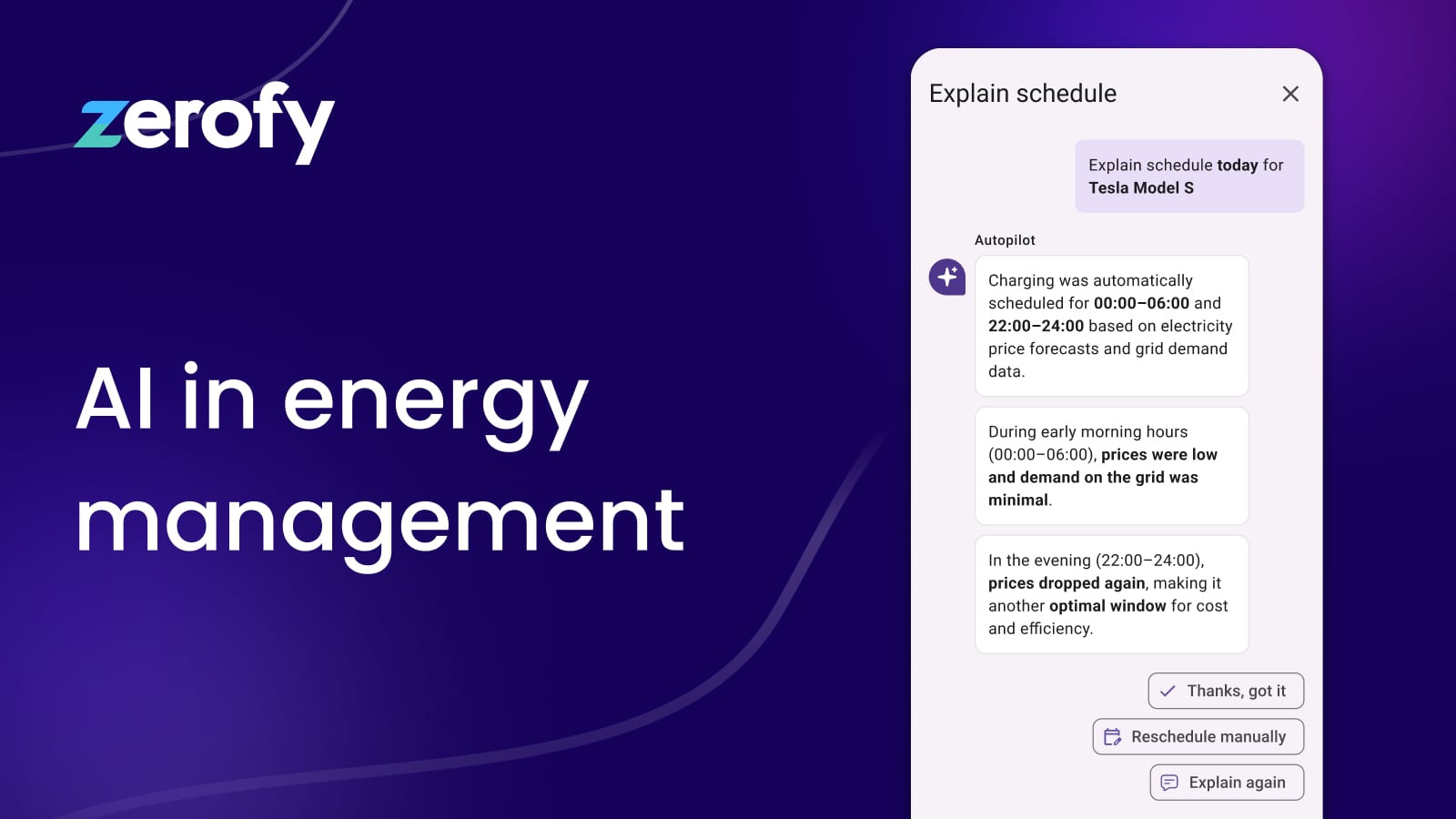
AI in energy management is often described as a single topic. In reality, it is better understood as three different layers that solve different problems: planning, forecasting, and user interaction.
In this post, we want to explain how we think about those layers inside Zerofy and where we see the strongest practical impact today.
1) Planning: deciding what should run and when
At the core of home energy management is the planning problem: given constraints, prices, forecasts, and user preferences, what is the best schedule for flexible devices?
For this part, classical optimization is usually the right backbone. These methods are designed to find optimal or near-optimal decisions under explicit constraints, which is exactly what this problem requires.
That is why in practice, modern energy systems are not “LLM-only” systems. The actual scheduling layer benefits most from mathematically grounded optimization.
2) Forecasting: improving the inputs to planning
Even the best planning method depends on input quality. Forecasting is therefore a second major AI layer.
In residential energy management, relevant forecasting targets include electricity price, home load, and solar production. All of these are time-series problems, and they often benefit from multivariate context. For example, heating-related load forecasts can improve with weather features, while solar forecasts depend strongly on sun and cloud dynamics.
At Zerofy, we have developed our own forecasting algorithms based on very recent domain-specific foundation-model approaches. We will share more technical detail on that stack in a separate deep-dive post.
3) User interaction: making optimization understandable
The third layer is the one most people associate with “AI” today: interactive communication via LLMs.
This is currently a major focus area for us because optimization quality alone is not enough. A plan can be technically correct and still feel confusing to users if the reasoning is opaque.
To address this, we built an LLM-based interaction tool that explains Zerofy plans in a conversational, chat-style format. Users can ask why the system scheduled a device at a certain time, what constraints were active, or how forecast and price inputs influenced a decision.
This is a practical and high-value use of AI: not replacing the optimization engine, but making its behavior transparent and easier to trust.
The feature is already implemented and currently in closed testing.
Why this three-layer view matters
When people discuss AI in energy, conversations often collapse into one generic debate. In product reality, separating these layers makes better engineering decisions possible.
- Planning asks for rigorous optimization under constraints.
- Forecasting asks for strong time-series modeling.
- Interaction asks for clear and adaptive communication.
Combining all three is how we see the next generation of practical home energy management: systems that are not only smart, but also understandable.