Q1 2026 Product Update

After our Q4 2025 update, the first quarter of 2026 was all about making Zerofy more complete and more practical for real homes. We focused on three big themes: bringing heating further into our energy management stack, improving the way complex meter setups are modeled, and making tariff handling more useful for day-to-day optimization.
This post summarizes the most relevant product updates we shipped between January and March 2026.
Heating is becoming a core part of the platform
In Q1, we expanded heating support with new integration work and reliability improvements. The biggest launch was Viessmann support in v2.28 (10 Mar 2026), while Vaillant users also benefited from stability improvements in the same period.
You can read more in our dedicated launch posts for Zerofy + Viessmann and Zerofy + Vaillant.
This matters because household optimization is no longer just an EV charging problem or a battery problem. In many homes, heating is one of the largest flexible loads. Integrating heat pumps more deeply means we can make better whole-home decisions instead of optimizing each device in isolation.
Better meter modeling for real-world installations
With v2.29 (24 Mar 2026) we shipped one of our most important foundations updates: flexible meter roles.
We covered this feature in detail here: New in Zerofy: Flexible Meter Roles.
Before this change, users with more advanced setups often had to work around rigid meter assumptions. Now each connected meter can be assigned the role it actually has in the installation. A meter can be set as a main grid meter (including bidirectional setups), as a production meter, or as a sub-meter for dedicated consumers.
This improves both clarity and quality. Data becomes easier to interpret in the app, and the planning engine gets cleaner input signals when making optimization decisions.
Tariff setup and price handling got a lot stronger
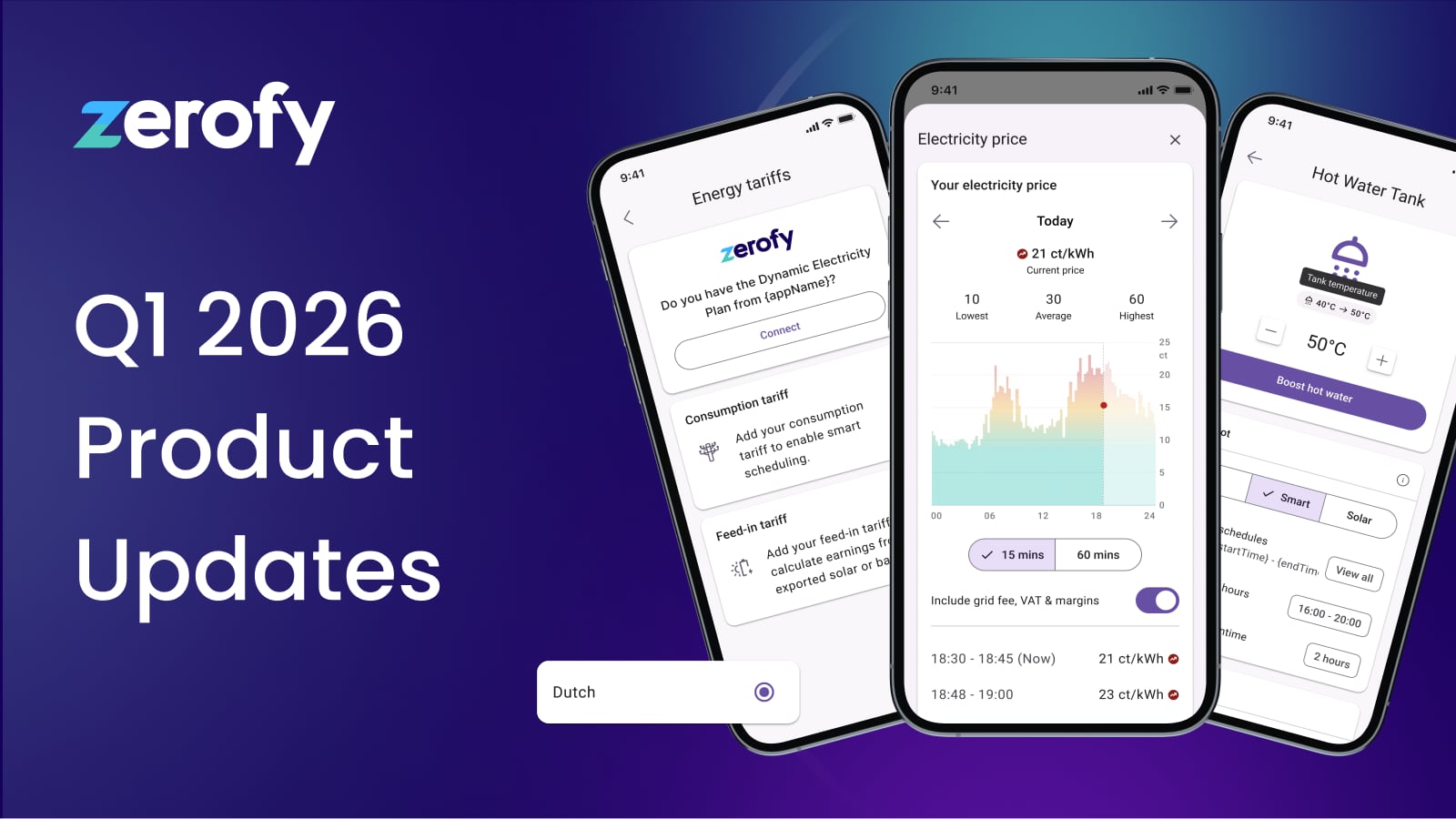
Q1 also brought several concrete improvements around electricity tariffs and prices. We improved tariff setup flows, introduced a new tariff provider selection assistant for DE, BE, and UK, and expanded chart handling for dynamic tariffs with both 15-minute and 60-minute visualization.
In addition, we improved tariff and price accuracy in additional markets, which is critical for cost-aware automation. If pricing inputs are weak, optimization quality drops quickly. Strengthening this layer was therefore a major focus for us.
For the next step in this area, see Energy Costs in the App, where we introduced direct in-app cost visibility.
Forecasting and daily UX also moved forward
On top of the larger architecture and integration work, we shipped a number of updates that improve daily use:
- Solar forecasts now include tomorrow, not only today.
- The Now screen shows home load in setups with a separate meter.
- Energy charts became interactive with tap-for-value support.
- Multiple app flow and UI refinements improved speed and usability.
These changes may look smaller on paper than a new integration launch, but they matter in practice because they directly affect how easy it is to trust and operate the system every day.
If you want a broader view of how this connects to our roadmap, read AI in Energy Management: Planning, Forecasting, and Explainability.
Thanks to everyone who tested early versions, reported issues, and shared setup edge cases with us. Those feedback loops continue to directly shape our roadmap.
We are carrying the same shipping pace into Q2.