
For fifteen years, the deal for a solar homeowner in Europe was simple: put panels on the roof, send the surplus to the grid, get paid a fixed rate or net it against your bill. Timing didn’t matter. A kilowatt-hour at noon in June was worth the same as one at 7 pm in January.
That deal ends in 2027. Across our core markets, regulators are moving at the same time and in the same direction. Feed-in tariffs are going away, net metering is going away, and grid fees are starting to depend on when and how hard you use the grid. A solar kilowatt-hour fed in at noon is now worth a few cents or less. One used at home in the evening is worth the full retail price.
The gap between those two numbers is what a home energy management system (HEMS) captures. In 2027 it stops being a nice-to-have.
Why now: the grid has more solar than it can use at noon
Regulators aren’t doing this on a whim. They’re reacting to success.
- Solar is mainstream. The EU passed 400 GW of installed solar in 2025 (406 GW), and solar delivered about 13% of Europe’s electricity that year (SolarPower Europe).
- Renewables are the majority in Germany. 58.8% of Germany’s net electricity generation in 2025 was renewable, with 74.1 TWh from grid-fed solar, up from 63.2 TWh in 2024 (Bundesnetzagentur).
- Negative prices are routine. Germany had 573 hours of negative wholesale prices in 2025, up from 457 in 2024 (Bundesnetzagentur). Across Europe, negative prices rose from under 0.5% of hours before 2022 to 3.4% of hours in 2025 (SolarPower Europe battery outlook, via ees Europe).
- Electrification is accelerating. Battery-electric cars took 17.4% of EU new registrations in 2025, up from 13.6% in 2024; 1.88 million BEVs were sold. In Germany BEV registrations grew 43% (ACEA via newmobility.news).
- Home batteries are already common in some markets. Nearly 40% of new residential solar systems in Europe came with a battery in 2025. In the Netherlands and Poland, more than half did (SolarPower Europe).
Put together: lots of solar at the same hour, lots of new flexible loads (EVs, heat pumps, batteries) and grids that weren’t built for either. Paying a flat rate for noon solar no longer makes sense for the system, so the price signals are changing. That is the regulatory push we see everywhere.
The tailwind, country by country
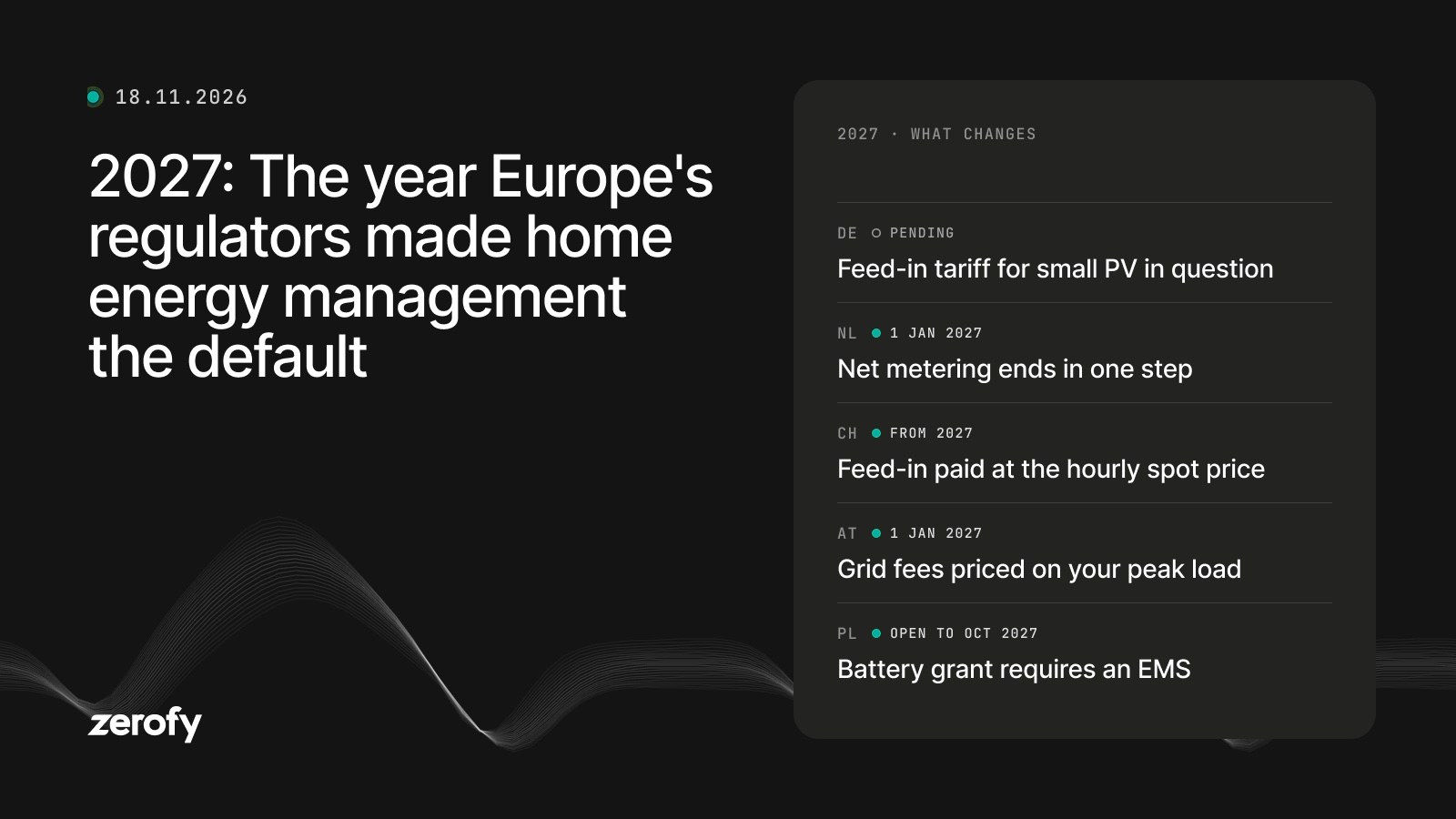
| Country | What changes | When | Status |
|---|---|---|---|
| Germany | Government draft: no more 20-year feed-in tariff for new small PV, transition payment, then direct marketing, 50% feed-in cap. Coalition MPs agreed in mid-November to keep the tariff up to 25 kW. | New systems from 1 Jan 2027 | Open: vote targeted for December 2026 |
| Netherlands | Net metering (salderen) ends in one step. Suppliers pay at least 50% of the bare supply price for feed-in until 2030. | 1 Jan 2027 | Law |
| Switzerland | Feed-in paid at the market price. From 2027 the reference becomes the hourly spot price, with a minimum premium for small systems. Grid operators may curtail up to 3% of solar output. | 2026, hourly from 2027 | Law |
| Austria | New grid tariffs with a capacity (kW) component. PV subsidies end; a planned storage bonus would require an energy management system. | 1 Jan 2027 | Grid tariffs: law; storage bonus: announced |
| Poland | Net billing at hourly market prices. The new home battery programme (PME 2) requires a working energy management system. | PME 2 open until Oct 2027 | Live |
Research status: 4 November 2026; Germany updated on 18 November 2026. Items marked pending, open or announced are not law yet.
Germany: small solar heads for the market, or does it?
Germany’s EEG reform, adopted by the cabinet on 29 July 2026, ends the fixed 20-year feed-in tariff for new small rooftop systems. Systems commissioned until 31 December 2026 keep their tariff. In the draft, new systems get a transition payment of about 5.2 ct/kWh for 36 months and then move into direct marketing at market prices, and feed-in from new rooftop systems is capped at 50% of capacity. The aim, in the government’s own words, is to push new installations toward storage.
The draft is not law yet, and it is changing. In mid-November, energy politicians of the governing coalition agreed to keep the feed-in tariff for systems up to 25 kW beyond the end of 2026, without the 50% cap. Systems from 26 to 50 kW would get the annual market value, larger ones would move into direct marketing, and the cap would apply from 26 kW. The level of the remaining tariff is not yet known, and CDU/CSU say nothing is final until the grid package is agreed as well. Bundestag and Bundesrat aim to pass the law in December. We will update this post when the final text is out.
Either way, the reform sits on top of rules already in place: dynamic tariffs that every supplier must offer, reduced grid fees for controllable heat pumps and wallboxes under §14a EnWG, and no feed-in payment during negative-price hours for new systems since February 2025. And even a feed-in tariff pays far less than the electricity you buy. The direction is clear: use your own solar, shift loads into cheap hours, and let the grid steer when it needs to.
Germany: EEG 2027 and the future of the feed-in tariff →
Netherlands: the end of salderen
From 1 January 2027, Dutch households can no longer net their feed-in against their consumption. There is no phase-out. Suppliers must pay at least 50% of the bare supply price (without tax) until 2030, which works out to roughly 5–6 ct/kWh. Many suppliers also charge feed-in costs, so the net value of exported solar is often well under 1 ct/kWh on fixed contracts. Meanwhile, every kWh used at home still avoids the full price, including energy tax. Self-consumption, home batteries and dynamic contracts become the main lever.
Netherlands: the end of net metering →
Switzerland: solar at market prices
Since 1 January 2026, Swiss grid operators pay feed-in at the quarterly market price unless they agree on something else, with a minimum of 6 Rp/kWh for systems under 30 kW. From 2027 the reference shifts to the hourly spot price at the moment of feed-in (with a transition period to 2028), plus a quarterly premium for small systems when market prices fall below the minimum. Grid operators may also curtail up to 3% of a system’s yearly production without compensation. New local electricity communities (LEG) let neighbours share solar with a grid-fee discount. Timing now matters in Switzerland too.
Switzerland: solar at market prices →
Austria: grid fees that depend on your peak
Austria’s new electricity law (ElWG) was passed in December 2025. From 1 January 2027 grid fees move toward a split between energy (kWh) and capacity (kW), so your highest load counts. The federal PV subsidy is expected to end for new modules from 2027. In its place, the ministry announced a storage bonus for new and retrofitted batteries that would require an intelligent energy management system. Peer-to-peer solar sharing has been allowed since October 2026.
Austria: ElWG and capacity-based grid fees →
Poland: batteries, but only with an EMS
Polish prosumers have been on net billing since 2022: surplus is credited to a prosumer deposit at market value (hourly or monthly) and used to pay for grid electricity. With evening prices sometimes many times higher than midday, self-consumption pays. The new home battery programme, PME 2, runs from 20 October 2026 to 1 October 2027 with a budget of up to PLN 1 billion. It pays up to 30% of a battery’s cost (up to PLN 16,000 for net-billing prosumers) and requires a working energy management system. Large suppliers have had to offer dynamic tariffs since 2024.
Poland: net billing and the PME 2 battery programme →
Beyond our core markets
The same pattern shows up elsewhere in Europe:
- Sweden scrapped the tax credit for micro-producers (0.60 SEK/kWh fed in) from 1 January 2026 (Skatteverket).
- France cut the feed-in tariff for new systems up to 100 kWp to 1.1 c€/kWh for applications from 5 June 2026 and abolished the self-consumption investment premium.
- Italy closed net metering (Scambio sul Posto) to new users in September 2025.
- Belgium has billed Flemish households on monthly peak capacity since 2023. Wallonia introduced time-of-use grid tariffs for smart-meter customers in 2026.
At EU level, the recast buildings directive (EPBD) makes solar the norm for new buildings, and the 2024 electricity market reform strengthens consumers’ right to dynamic contracts and energy sharing.
What this means
For homeowners, the value of a solar system now depends on how much of it you use yourself and when. A HEMS that charges the battery and the car from surplus solar, runs the heat pump in cheap hours and avoids peaks turns the regulatory changes from a loss into a gain.
For installers and energy suppliers, “panels plus feed-in tariff” stops being a sales pitch. Systems sold in 2027 need a story about self-consumption, batteries, dynamic tariffs and grid fees. Software that controls the devices across brands is how you tell that story, and it creates recurring revenue after the installation is done.
How Zerofy fits in
Zerofy is a cloud HEMS. It connects to the inverters, batteries, wallboxes, EVs and heat pumps people already own, across more than 80 brands, through the manufacturers’ official APIs, without extra hardware. It optimises them against solar forecasts and dynamic prices.
Installers and energy suppliers can offer Zerofy co-branded as resellers, as their own white-label app, or through our HEMS & DER API.
Read what changes in your country:
- Germany: EEG 2027 and the future of the feed-in tariff
- Netherlands: the end of net metering
- Switzerland: solar at market prices
- Austria: ElWG and capacity-based grid fees
- Poland: net billing and the PME 2 battery programme
Sources
- SolarPower Europe: EU hits 2025 solar target (11 Dec 2025)
- SolarPower Europe: European battery storage surges in 2025 (23 Jun 2026)
- ees Europe: European Battery Market Outlook 2026–2030 key figures (30 Jun 2026)
- Bundesnetzagentur: 2025 electricity market data (5 Jan 2026)
- newmobility.news / ACEA: EU car registrations 2025 (27 Jan 2026)
- Skatteverket: Mikroproduktion av förnybar el
- SurgePV: Solar subsidies Europe 2026 tracker (France, Italy)
- European Commission: Energy Performance of Buildings Directive
- European Commission: Electricity market design
- pv magazine: EEG-Novelle – Einspeisevergütung für kleine Photovoltaik-Anlagen könnte doch erhalten bleiben (15 Nov 2026)
- pv magazine: Diese Änderungen am EEG-Entwurf könnten noch kommen (16 Nov 2026)
- Country sources: see each country page.