
When we started Zerofy, we set out to build the cloud HEMS the market did not have: smart energy management for any home, in your brand, with no extra hardware in the meter cabinet. Since then we have kept building out the ecosystem around it, one piece at a time. Today we are adding the last one.
How the ecosystem came together
- Whitelabel. Your own energy app in the App Store and on Google Play, in your brand colours, running on the Zerofy cloud HEMS and Autopilot.
- Mission Control. Earlier this year we launched the back office for installers and energy providers: fleet overview, households, devices and support in one place.
- Reseller co-branding. Just last week we opened co-branding on our consumer app: sign up, upload your logo and sell Zerofy licences under your own name, with no set-up fee and the margin on every household yours. It has been popular with installers and energy providers from day one.
That covers anyone who wants an app, either their own or ours with their logo on it. One piece was missing: the companies that already have an app, or want to build their own. That piece is the API.
This is not our first API. We have built interfaces for individual partners before, each one scoped to a single project and agreed before a line of code was written. What is new is that the whole HEMS stack — connect, status, history, control — is now one documented product API, the same for everyone, and anyone can start using it directly.
Who the API is for
Companies that already have an app. Many energy providers already have a customer app for contracts, bills and meter readings. With the API they add our cloud HEMS stack behind it: device connectivity, live status and history, and control, without building a HEMS or launching a second app.
Anyone building a new app. Startups, OEMs, proptech and smart home platforms that want energy management in their own product, with the hard parts already done.
What it does
Connect. Create a home and send your customer to a page hosted by Zerofy where they authorise their device account. No hardware, no site visit. If a connection breaks, a repair keeps the devices and all of their history.
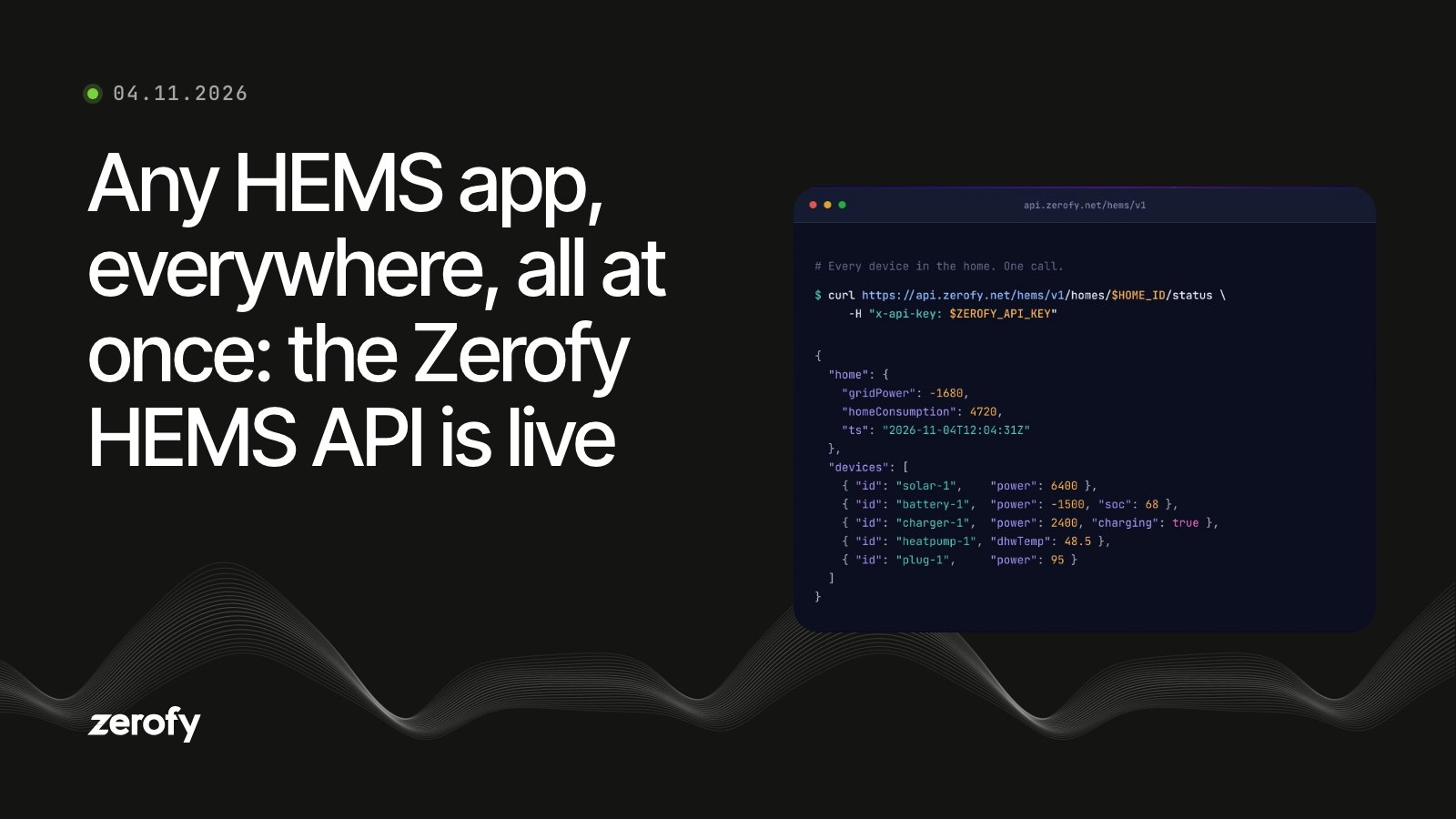
Status. One call reads every device in the home: solar, battery power and charge level, grid at the main meter, home consumption, EV charging, heat pump and hot water temperatures, smart plugs. Every reading carries its own timestamp, and a manufacturer cloud that is unreachable never makes equipment disappear.
History. Stored energy per device at five-minute, fifteen-minute, hourly or daily intervals, for charts, reports or billing. Gaps are explicit, so you never have to guess.
Control. Start a schedule on a device: charge or discharge a battery, start or stop EV charging, boost hot water, set a heat pump, switch a plug. Every command has an end — at most 24 hours — and the device then returns to its normal state. Commands are idempotent, so a retry never double-commands a device.
Autopilot. Writing your own optimiser on top of status, history and control is entirely possible, and some partners will want exactly that. For everyone else, switching on Zerofy’s Autopilot for a home is next on the API roadmap: the same planning around dynamic prices, solar forecasts and departure times that runs in the Zerofy app every day. Talk to us if you want it in your first release.
The unit is the home
Most energy APIs are asset APIs: one inverter, one car, one charger. That is useful, but a home is not a single device. It has solar, a battery, an EV, a heat pump and a meter, often from five different manufacturers, and the value comes from running them together.
The Zerofy HEMS API is built around the dwelling. You still get everything an asset API gives you, every device on its own, on a platform that speaks to 80+ brands. But you also get the home: which devices belong together, one main meter, the home’s grid power and consumption, and the groundwork for optimising all of it at once.
Brands are enabled on the API step by step, so tell us which ones you need and we will prioritise them.
Who owns what
The split we see in almost every project is simple. Everything around your customer and your ecosystem stays with you: user management, identity and login, contracts and billing, your app and your brand. Everything about the home and its energy lives with us: the dwelling, the device connections, the energy data, forecasts and optimisation.
Your API key identifies your company. We never need your users’ identities: you map your customers to homes with your own reference, and sandbox and live are fully separate environments.
Your first calls
# List your homes
curl https://api.zerofy.net/hems/v1/homes \
  -H "x-api-key: $ZEROFY_API_KEY"

# Live power and state of every device in a home
curl https://api.zerofy.net/hems/v1/homes/$HOME_ID/status \
  -H "x-api-key: $ZEROFY_API_KEY"

# Hourly energy history for one device
curl "https://api.zerofy.net/hems/v1/homes/$HOME_ID/devices/$DEVICE_ID/history?interval=PT1H&from=2026-11-01T00:00:00Z&to=2026-11-02T00:00:00Z" \
  -H "x-api-key: $ZEROFY_API_KEY"
REST and JSON, an OpenAPI reference in your partner area, separate keys for sandbox and live, and idempotent commands. That is the whole learning curve.
Live now, with a sandbox
We wanted this to be easy for everyone to start, so there is no sales call and no waiting list. Sign up, enable the API in your partner area and get a sandbox key straight away.
The sandbox is a home you fill yourself. Create virtual devices of any type — solar inverter, battery, meter, EV, EV charger, heat pump, water heater, smart plug — give them the values you want to see, and build against them exactly as you would against a real home. When you are ready for real homes, request live access.
The price is a flat €3 per active home per month, with no set-up fee and a one-month minimum term — all the way up to 500 homes, without ever talking to a salesperson. Above that, ask us about API Enterprise.
Any HEMS app, in hours
A clean API at the level of the home plus today’s AI coding tools changes what a HEMS app costs to build. It is no longer a project of months.
To show what we mean, we have been building home screens on the same home and the same data: a 90s point-and-click adventure, a medieval chronicle, the gods of Olympus and a blocky voxel world. Same solar, same battery, same car, four very different apps.
Here is the voxel one, BlockWatt. It is not a mockup: it runs against a sandbox home and reads its ten emulated devices through the same /status call you saw above.
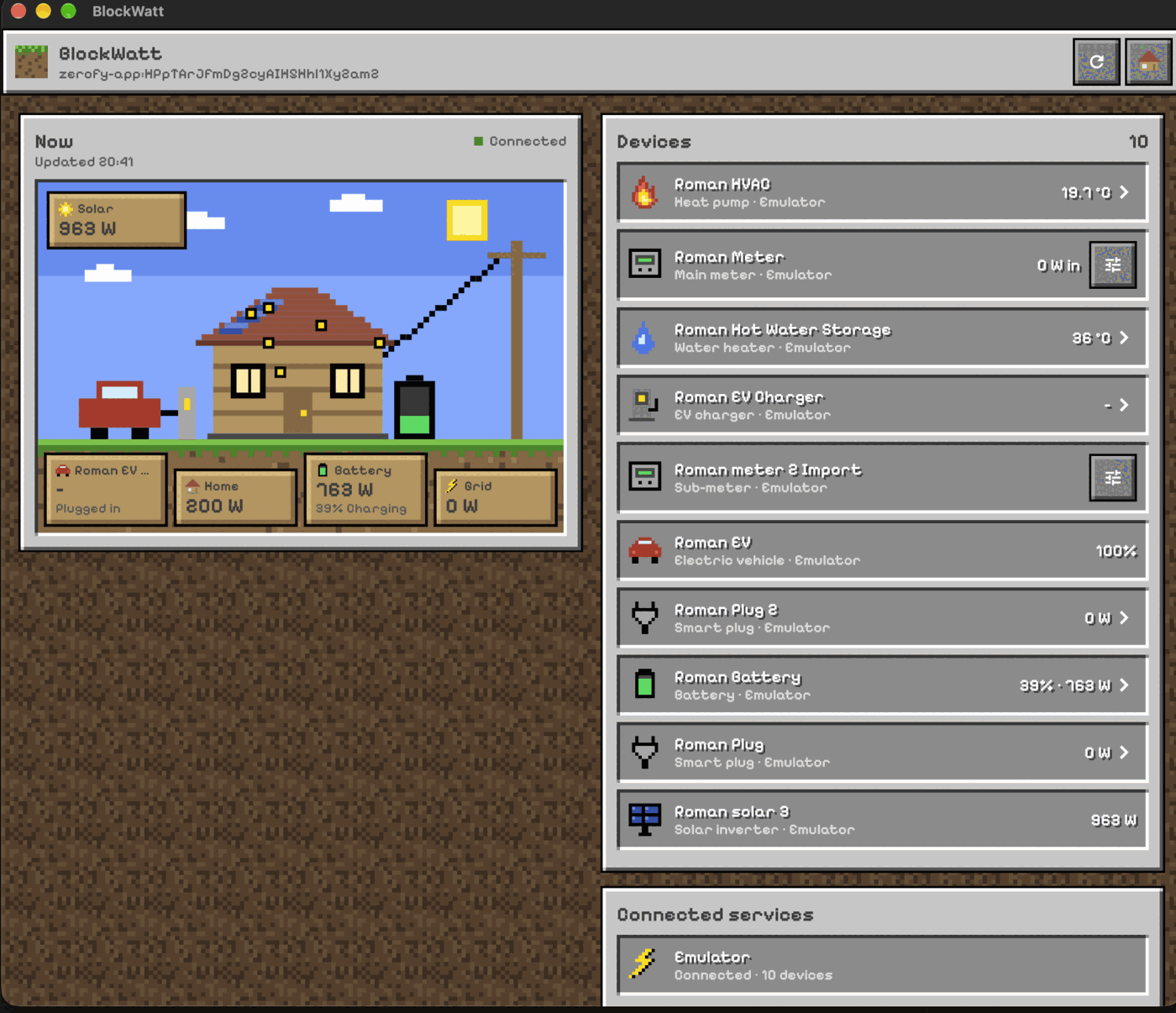
Any HEMS app, everywhere, all at once. What will you build?
Get started
Don’t build a HEMS. Build on one. Sign up and get your API key, or book a call if you would rather talk it through first.