
“Can I put a BYD on my Fronius?” is probably the most common battery question installers get, closely followed by “and will Zerofy see it?”. The answer rarely depends on the brand. It depends on two decisions that are made before the brand: how the battery is coupled to the solar system, and at which voltage it runs. This post explains both, and then why not every battery fits every inverter.
DC coupled: the battery behind a hybrid inverter
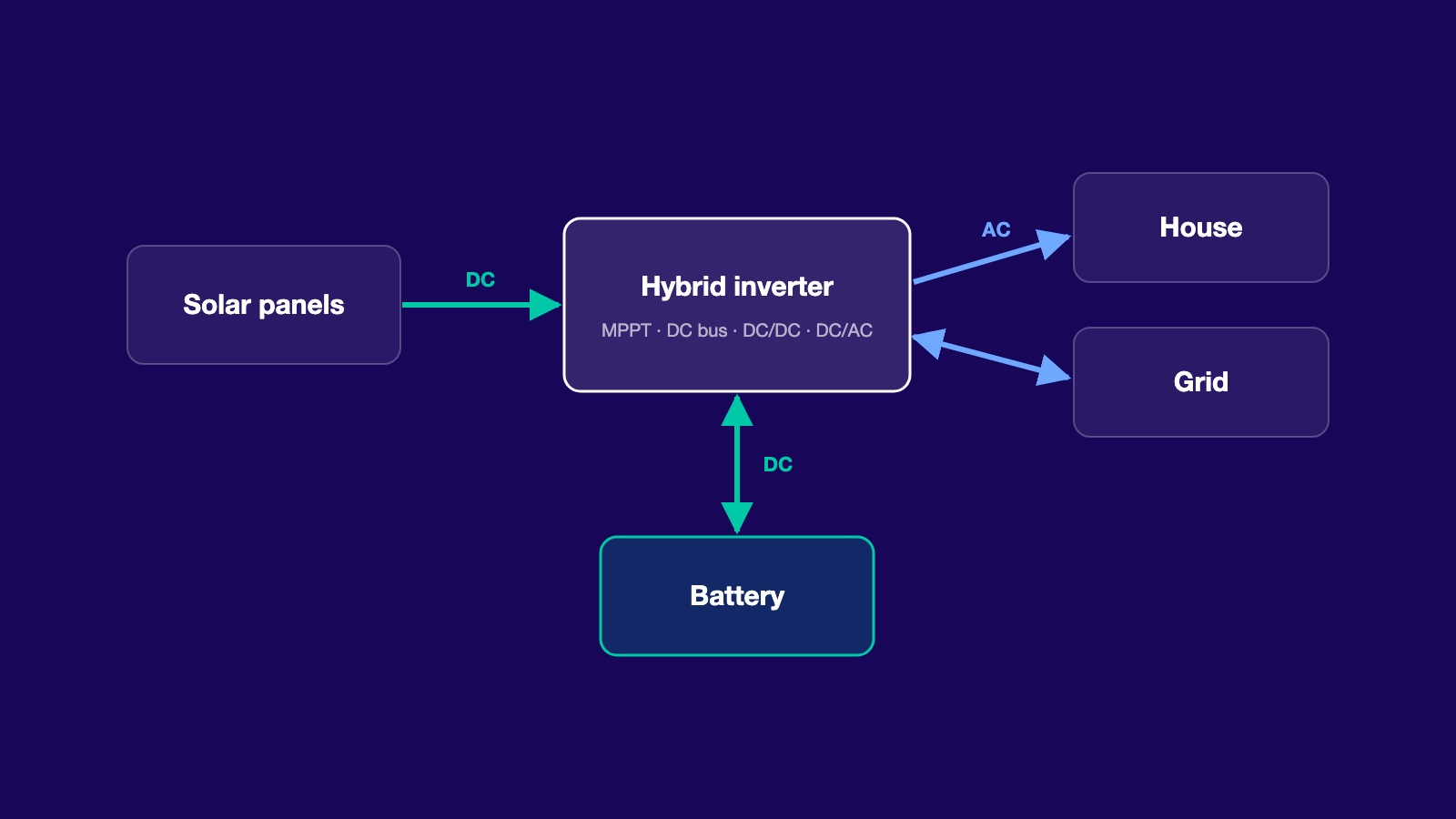
A hybrid inverter is a solar inverter with a second DC input for a battery. The panels and the battery share the inverter’s internal DC bus, so solar power charges the battery as direct current and is converted to alternating current only once, when the house actually uses it. That is DC coupling, and it is how most new home storage systems are built today.
The advantages are easy to see. There is one device instead of two, only one DC-to-AC conversion, and surplus solar above the inverter’s AC rating still charges the battery instead of being clipped. Backup power is a small add-on rather than a separate project.
The catch is just as clear: the inverter controls charging. Its DC/DC stage and its firmware have to know the battery, so the battery must be on the inverter’s approved list. Typical DC-coupled hybrids are the Fronius GEN24 Plus, SMA Sunny Tripower Smart Energy, Huawei SUN2000, Sungrow SH, GoodWe ET, Solis S6, Deye SUN-SG and Kostal Plenticore.
AC coupled: a battery with its own inverter
An AC-coupled battery brings its own inverter and connects on the AC side of the house, next to the existing solar inverter. The solar inverter does not know the battery exists.
That makes it the right choice when a solar system is already in place and you do not want to replace its inverter, when the roof uses microinverters, or when the battery sits far from the solar inverter. The price is one extra conversion, which costs a few percent of the stored energy, and compatibility is now defined by the battery inverter rather than the solar inverter. SMA Sunny Boy Storage, Victron MultiPlus-II, Tesla Powerwall, Enphase IQ Battery, Anker SOLIX and EcoFlow PowerOcean all work this way.
A third group skips the question entirely. All-in-one systems such as Huawei LUNA2000, Fronius Reserva, FoxESS EP11, Sigenergy SigenStor, E3/DC or sonnen sell inverter and battery as one product. Nothing to match, but nothing to choose either.
High voltage or 48 V?
Home batteries come in two voltage classes. High-voltage (HV) batteries connect their modules in series and reach 150 to 600 V. Low-voltage (LV) batteries run at 48 V (51.2 V with LiFePO4 cells) and add capacity by connecting modules in parallel. Both store the same energy. They differ in current, efficiency, compatibility and in how they grow.
| High voltage (HV) | Low voltage (48 V) | |
|---|---|---|
| Current at 5 kW | about 12 A at 400 V: thin cables, low losses | about 100 A: thick cables, big fuses, more losses |
| Efficiency | typically 2–3 points better round trip | boosting 48 V to the 400 V bus costs 2–3 % |
| Compatibility | short, series-specific lists: a Fronius GEN24 takes three battery brands | widest: the Pylontech and BYD protocols are de facto standards, Deye, Victron, GoodWe ES, Solis, Growatt and Sofar list dozens of batteries |
| Expansion | same series, usually same age; limited later on | add a module in parallel, even years later |
| Typical use | three-phase hybrids, 10–30 kWh | single-phase and smaller hybrids, off-grid, backup, self-build |
| Price per kWh | higher | lowest, huge choice of brands |
So which one? For a new three-phase system of 5 to 20 kWh, HV is the default, and the inverter choice narrows the battery choice to two or three brands. 48 V suits smaller single-phase systems, off-grid and backup setups, and anyone who wants to grow the battery step by step or pick from a dozen brands. Either way: choose the inverter first, then the battery from its list.
Why not every battery works with every inverter
A DC-coupled battery is not a dumb box of cells. Its battery management system (BMS) and the inverter talk constantly, and the inverter decides how to charge. Four things have to match.
The voltage window. 48 V and 400 V batteries are not interchangeable, and even an HV stack must fall inside the inverter’s input range. That is why approval lists name module counts: BYD HVM from 11 kWh on a Fronius GEN24, not the 8.3 kWh version.
The communication protocol. The BMS reports state of charge, limits and alarms over CAN or RS485, and every brand speaks its own dialect. The inverter firmware needs a profile for that exact battery, or the battery stays disconnected.
Firmware versions. Approvals are tied to firmware on both sides. Pylontech Force H3 works on the SMA Sunny Boy Smart Energy only from BMS firmware 1.6, and is not compatible with the Fronius GEN24 at all. A list from 2022 can be wrong today.
Testing, warranty and certification. Manufacturers only warrant tested combinations. An unlisted battery runs without warranty on both sides and may fall outside the grid operator’s certificate. Huawei, FoxESS, Enphase and Sigenergy keep their ecosystems closed; SMA, GoodWe, Solis, Deye, Kostal and Victron publish long lists.
Which batteries are approved for which inverter, series by series, is in our home battery database.
What this means for Zerofy
With a DC-coupled battery, Zerofy never talks to the battery itself. It connects to the inverter’s cloud, such as Fronius Solar.web, SMA Sunny Portal, Huawei FusionSolar, Sungrow iSolarCloud, GoodWe SEMS, SolisCloud or Deye Cloud, and the inverter reports the state of charge and power of whatever battery is on its DC bus. A BYD on a Fronius, a Pylontech on a GoodWe or a Dyness on a Solis all show up through the inverter integration. The battery brand does not matter; the inverter brand does.
Which control features are available, such as battery mode, forced charging and Autopilot, depends on the inverter integration, not on the battery. The capabilities table lists them per inverter brand. AC-coupled and all-in-one systems such as Anker SOLIX, EcoFlow, Zendure or Sigenergy have their own integrations.
So the next time someone asks whether their BYD will work on their Fronius: check the Fronius list for the battery, and check the Zerofy list for the Fronius. That is all there is to it.